
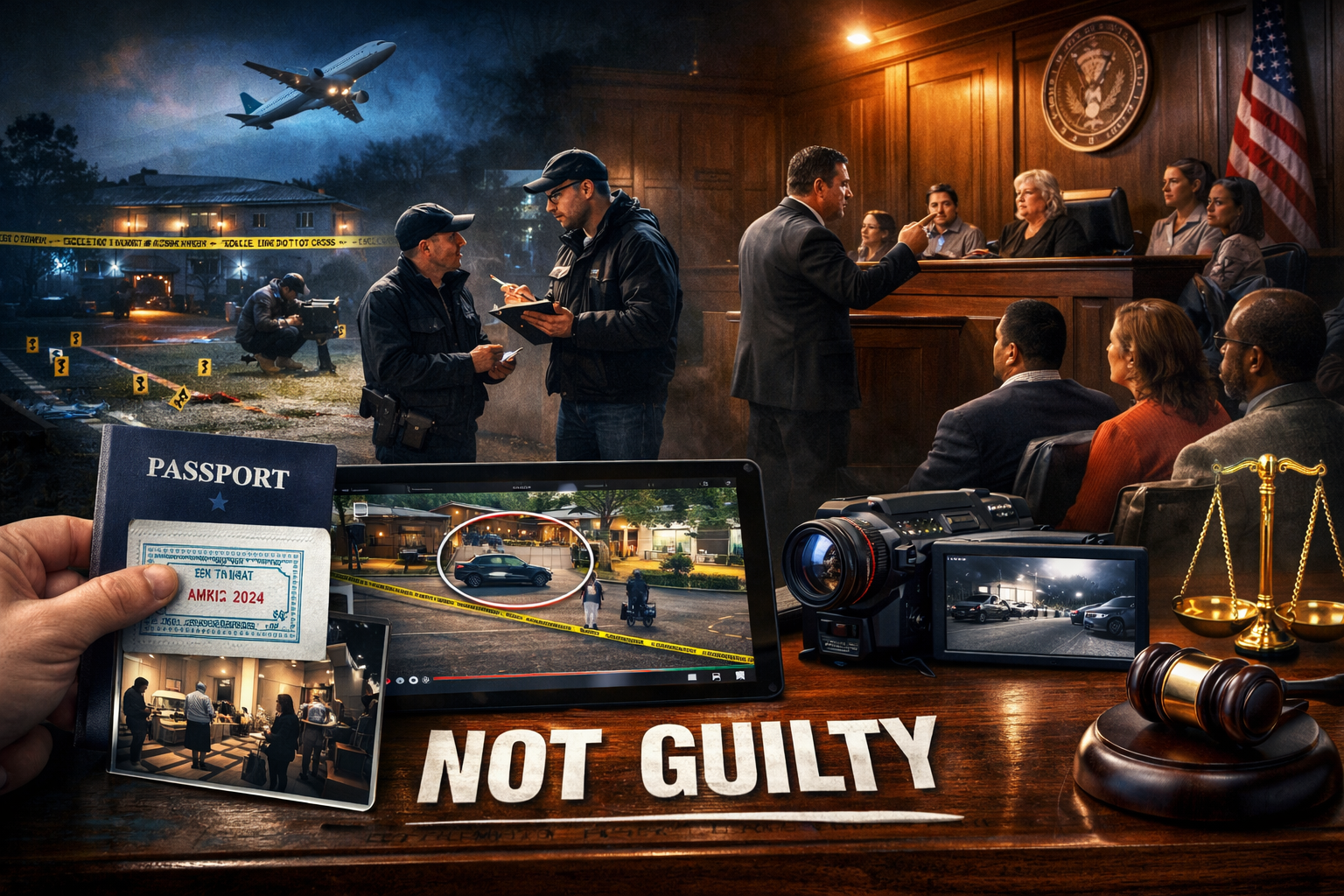
Case Result Spotlight: Murder Charge,… Verdict Not Guilty
In 2024, our firm was retained to assist in the defense of a client charged with murder with a firearm. Law enforcement responded to the scene and obtained statements from seven witnesses. From the beginning, the District Attorney’s Office indicated it was not willing to negotiate, with no offers and no plea discussions.
What the State Alleged
According to the police report, investigators alleged our client drove to a restaurant knowing the victims were there, waited for the victims to leave, then exited his vehicle and opened fire, shooting one victim seven times and another five times. One victim died at the scene. The second victim fled and survived with non-life-threatening gunshot injuries.
Multiple witnesses told police they saw the shooter exit the vehicle, raise his arm, and fire at both victims, and the State asserted that shooter was our client.
Our Investigation, Built Step by Step
From our first meeting with the defense team, we approached this case the way high-stakes matters demand: verify everything, assume nothing, and document every step. After reviewing discovery, consulting with counsel, and interviewing our client in custody, we identified several investigative priorities. Our client denied involvement and stated he was in another country at the time of the shooting.
1) Immediate Priority, Verify Location and Movement
We began verifying the client’s location at the time of the offense. This required border-crossing verification, including federal records, and international interviews and supporting documentation in a third country. Because these records take time, we initiated this process immediately while working other leads in parallel.
2) Re-Interview Witnesses and Test the Claims
While awaiting federal and international responses, we tracked down and interviewed the witnesses listed in the police and DA reports. We asked each witness to describe, in detail, exactly where they were positioned, how they knew shots were fired, what they did immediately after the first shots, and what they personally observed versus what they later heard from others.
During these interviews, we uncovered significant inconsistencies between witness accounts and what was recorded in official reports.
3) Crime Scene Reconstruction and Drone Mapping
We conducted a full scene examination and reconstruction. This included on-site measurements, drone imagery, line-of-sight analysis using angles, distances, and elevation, and witness-position verification based on where each person said they stood.
One of the most significant discoveries was that a witness whose statement suggested a clear view could not actually see the location where the shooting occurred. That witness heard gunfire, responded after it ended, and then absorbed details from other people on scene, an environment where false or implanted memories can occur in traumatic events.
As we continued interviewing and verifying witness positions, a critical pattern emerged. Although reports implied all seven witnesses saw the shooter, only two truly had a direct line of sight. The others were repeating what they heard immediately afterward, honestly believing they had seen it. Even among the two who did see the shooter, there were conflicts about the shooter’s appearance, clothing, vehicle description, and what was said during the incident.
4) Confirm the Alibi Internationally
We ultimately obtained documentary and video evidence proving our client was in another country at the time of the shooting, including hotel receipts and registration records, hotel security video showing our client, interviews with staff, and corroboration from nearby businesses.
Two nearby businesses provided affidavits confirming they interacted with our client at the relevant time, directly contradicting the State’s timeline.
We also located additional witnesses who were at the scene but were never interviewed by police. Two of these witnesses had photographs from the scene and agreed on the vehicle involved. Although they could not identify the shooter, they stated they saw through the window that the shooter was a Black male, information inconsistent with the State’s identification theory.
This is a known problem in major cases. Once investigators believe they have the answer, they often prioritize information that confirms it. That is confirmation bias. Our job is to break that cycle by documenting all credible facts, whether they help the State’s theory or not.
5) The State’s Bluff, Verified and Disproved
Despite mounting contradictions and exculpatory evidence, the prosecution pressed forward and claimed the surviving victim had left the country, that they were in contact, and that the victim was returning to testify.
We verified those claims and found they did not hold up. We confirmed no visa application had been submitted for the victim’s return. The flight information provided did not match the victim. The State then changed course and claimed the victim would testify by Zoom from abroad.
We located the victim internationally, traveled to the victim’s country, and interviewed them directly. We approached the conversation with empathy because the victim endured a traumatic event regardless of who fired. The interview made one fact clear. The victim was not in contact with the DA’s office and did not know the trial date.
Trial Outcome, Not Guilty
At trial, the defense proved our client was where he said he was and that multiple witnesses were mistaken about what they believed they saw.
During our scene canvass, we also located previously unknown surveillance footage from a nearby hidden camera, which clarified the sequence of events and further undercut the State’s narrative.
The jury considered the full record and returned a unanimous verdict: Not Guilty.
Justice matters. One person is dead and another suffered serious injuries. But justice requires the truth, and the real shooter must be held accountable, not an innocent person.
Why This Matters
Without the evidence our team developed, our client likely would have been convicted of a crime he did not commit. That evidence included:
- Border-crossing verification
- International hotel registration and security footage
- Affidavits from independent businesses
- Witness re-interviews and documented inconsistencies
- Crime scene reconstruction and drone mapping
- Previously unknown surveillance footage
- Verification and location of the surviving victim internationally
- Alternative suspect theories showing motive and capability
- The fact that the firearm was never recovered
Update
The State has now charged another individual with this crime, with trial currently scheduled for later in 2026. We are not involved in the new suspect’s case or defense.
Disclosure
Cabit does not break the law to solve cases. This case study is a high-level summary written for marketing purposes and is not a detailed investigative report. Our investigative reports are confidential and often contain private, personal, and sensitive information. They are shared only with our clients.